

Trust Lawyer Gilbert, AZ
If you own a home in Gilbert, have children you want to protect, or want to spare your family from the cost and delay of probate court, a trust probably belongs in your plan. The challenge is that trusts come in many forms, and the wrong one can leave gaps that create the very problems you were trying to prevent. A revocable trust and an irrevocable trust serve entirely different purposes. The funding process matters as much as the document itself.
A Gilbert, AZ trust lawyer can help you sort through those decisions and build a plan that actually works when your family needs it. LifePlan Legal AZ has been drafting trusts for Arizona families for more than 20 years. We offer free consultations.
Why Choose LifePlan Legal AZ for Trust Planning in Gilbert, AZ?
Deep Roots in Arizona Estate Planning
Jake Carlson founded LifePlan Legal AZ and has handled estate planning matters in Arizona off and on for over two decades. He started doing this work in-house back in 2005, stepped away from it between 2010 and 2017, and returned to focus on wills, trusts, and related planning full-time. Jake earned his J.D. from California Western School of Law with a concentration in tax and estate planning, and he holds an MBA from San Diego State University in financing emerging enterprises. He also carries the Certified Exit Planning Advisor designation, which sharpens his understanding of how business interests and trust structures fit together. He is a member of the State Bar of Arizona Probate & Trust Section.
Rebecca Easton brings over a decade of practice across Arizona and Colorado. Her J.D. is from the University of Denver Sturm College of Law, and she holds an undergraduate degree in psychology and Spanish linguistics from the University of Arizona. She is a member of the State Bar of Arizona Probate & Trust Section and the Elder Law Section, the Colorado Bar Association, and the East Valley Estate Planning Council. Becky ran her own practice for seven years before merging with LifePlan Legal AZ in 2025. She has a particular strength with blended families and has navigated trust administration disputes where multiple parties had competing interests.
Glenn McMinn holds both a J.D. and a B.S. in Finance from Arizona State University. He is a member of the State Bar of Arizona and the Phoenix Association of Realtors. Glenn is also involved in the community through the Apache Junction Wrestling Club.
Results That Show Up in Real Families' Lives
Jake assisted a client in transitioning a 30-person corporation to a successor, a matter that required careful coordination between business succession planning and the owner's personal estate. Becky has established asset protection trusts for high-net-worth individuals and business owners, and she has guided families with complex blended-family dynamics to peaceful resolutions. Our attorneys have helped hundreds of families across the East Valley build plans that actually hold up when tested.
Pricing You Can Plan Around
Most of our trust work is billed at a fixed fee, typically between $2,000 and $5,000 depending on complexity. We discuss the number during the initial consultation. No surprises afterward.
⭐⭐⭐⭐⭐
"We had a great experience working with the team at LifePlanAZ while helping my grandfather with estate planning. They were patient, knowledgeable, and took the time to explain everything clearly, which made a stressful process feel much more manageable. Their guidance was thoughtful and thorough, and we truly felt supported every step of the way. I would absolutely recommend LifePlanAZ to anyone looking for trustworthy and compassionate estate planning support!" — Alexa Kubinski
Read more reviews on our Google Business Profile.
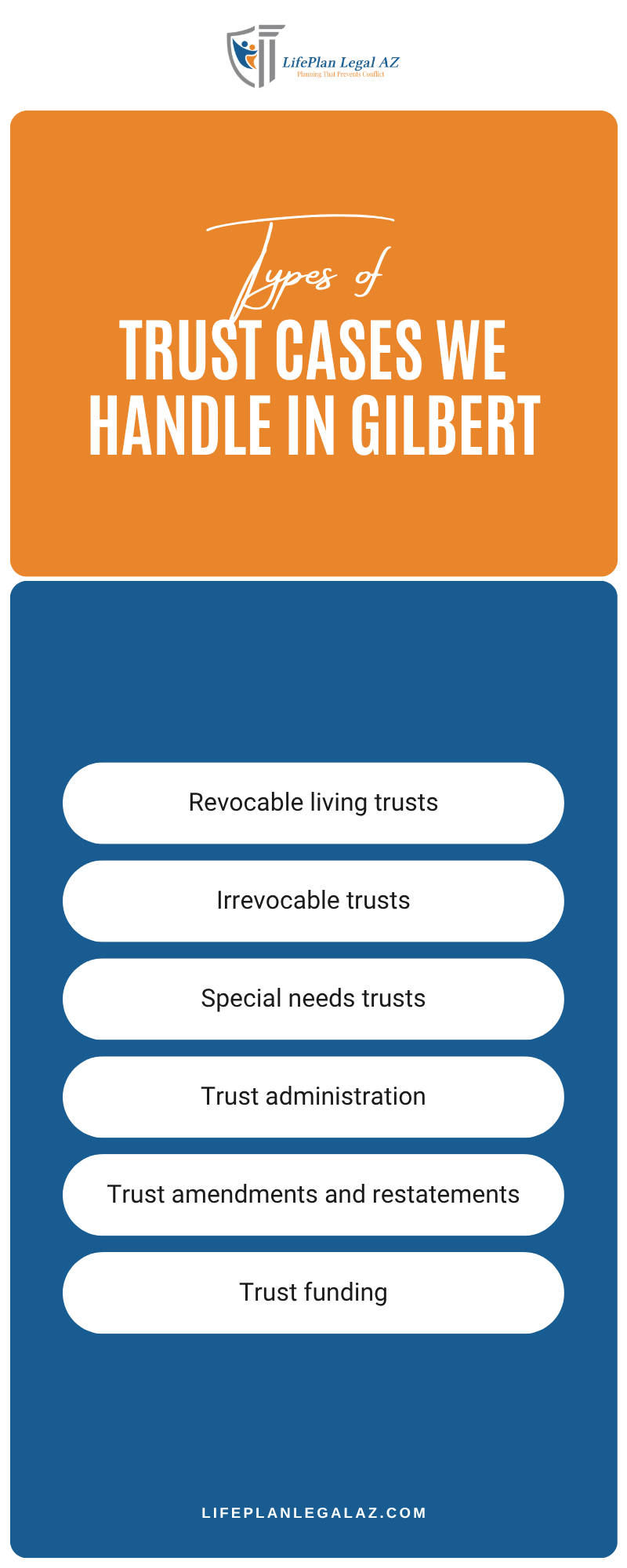
Types of Trust Cases We Handle in Gilbert
Every trust matter we take on starts with a conversation about what the client actually needs. We don't use templates. Here is what we work on regularly:
- Revocable living trusts. This is the trust most people think of first. You keep full control over your assets during your lifetime, you can change or revoke the trust whenever you want, and when you die, your assets transfer to your beneficiaries without going through probate. It is flexible. But it offers no creditor protection while you're alive, which is a trade-off worth understanding.
- Irrevocable trusts. Once you create one, you generally cannot take it back. That sounds harsh, but it serves a purpose. Irrevocable trusts are the tool we use for asset protection, Medicaid planning, and reducing a taxable estate. Clients who need to shield assets from future creditors or long-term care costs use these.
- Special needs trusts. If someone in your family has a disability, a properly written special needs trust lets you provide for them without endangering their eligibility for AHCCCS, SSI, or other government benefits. The language in these trusts has to be exact. A careless sentence can disqualify your loved one from the programs they depend on.
- Trust administration. After the person who created the trust dies, the successor trustee takes over. That trustee owes legal duties to the beneficiaries: notifications, accountings, distributions. We guide trustees through each requirement.
- Trust amendments and restatements. A divorce. New grandchildren. A move to another state. Changes in tax law. Any of these can mean your trust needs updating. We handle reviews and modifications regularly.
- Trust funding. This is the part that trips people up. A trust that hasn't been funded is just a stack of paper. Real property requires a new deed recorded with the county. Bank and investment accounts need to be re-registered. Beneficiary designations on retirement accounts and life insurance must coordinate with the trust rather than conflict with it. An unfunded trust is one of the biggest mistakes we see, and it is entirely avoidable.
Gilbert Trust Infographic
Arizona Legal Requirements for Trusts
Arizona trust law is governed by the Arizona Trust Code, housed in Title 14, Chapter 11 of the Arizona Revised Statutes.
To create a valid trust in Arizona, the settlor must have the intent to create one, must designate identifiable property, and must name a beneficiary who can be ascertained now or in the future. Notarization is not legally required, but it can prevent challenges. One rule that catches people: a trust created by a written instrument can only be amended or revoked by another written instrument. You cannot change your trust verbally. That is black-letter Arizona law.
Arizona has one of the most favorable rules against perpetuities in the country. Under A.R.S. § 14-2901, non-vested property interests must vest within 500 years. Five hundred. That is not a typo. It gives families enormous flexibility for dynasty trusts and multi-generational wealth transfer strategies that would be impossible in states with shorter time horizons.
When a revocable trust's creator dies, the trust becomes irrevocable. At that point, the successor trustee steps into a fiduciary role governed by the trust code. The duties include acting in good faith, keeping beneficiaries reasonably informed, and administering the trust according to its terms. Arizona's probate court has jurisdiction over trust disputes, including petitions to remove trustees, contests to trust validity, and breach of fiduciary duty claims.
Key Components of a Gilbert Trust
Choosing the Right Type
This decision matters more than any other. A revocable trust gives you flexibility and avoids probate but offers no creditor protection. An irrevocable trust sacrifices control in exchange for protection or tax advantages. Which one you need depends on what you own, who you're planning for, and what you're most worried about. We spend significant time on this question because getting it wrong often means starting over at the worst possible moment.
Naming Your Trustee and Successors
Most people name themselves as the initial trustee and designate a successor for when they die or become incapacitated. The successor choice matters enormously. This person will manage everything you own. They need to be organized, trustworthy, and willing to accept fiduciary obligations that carry genuine legal weight. We walk every client through the trustee's responsibilities so they understand what they are asking of someone.
Funding the Trust
Real property needs a new deed. Bank accounts need re-registration. Investment accounts need updated titling. Beneficiary designations on retirement accounts and life insurance need to work with the trust, not against it. We handle all of this with our clients. A trust sitting unfunded does nothing for anyone.
Distribution Provisions
You decide how and when your beneficiaries receive assets. Outright at a certain age. Staggered over time. Ongoing management with distributions for health, education, maintenance, and support. Families with a child dealing with addiction or financial immaturity often need discretionary provisions to protect the inheritance.
Powers of Attorney and Companion Documents
A trust alone is not a complete plan. You still need a power of attorney for finances, a healthcare directive, and a pour-over will to catch any assets that weren't titled in the trust before you died. We create all of these together and make sure they actually coordinate with each other.
Reviews and Updates
We recommend reviewing your trust every three to five years or after any major life event. Marriage. Divorce. A new child or grandchild. A significant change in what you own. Tax law shifts. A trust that reflected your wishes in 2018 might not serve you well in 2026, and a periodic review is the only way to catch that.
Contact LifePlan Legal AZ
Whether you are creating your first trust or updating one that was drafted years ago, our Gilbert office is ready to help. We offer free initial consultations and will tell you what we recommend, why, and what it will cost before we begin.
Contact us to set up a time to talk.
Trust Statistics in Gilbert
 Whether a trust earns its place in your plan often comes down to one thing: real estate. Most Gilbert households own their home rather than rent, and the town's median home value sits well above half a million dollars, according to the U.S. Census Bureau. A home that is high in value is exactly the kind of asset families want to keep out of probate court, and a trust is the most common tool for doing it, which our Gilbert, AZ trust lawyer can help with.
The paperwork that moves a home into a trust runs through one local office. The Maricopa County Recorder records roughly a million documents a year, including the deeds that fund Gilbert trusts. With more than 90,000 households in town, the demand for clean, recorded transfers is not going away.
Common Myths About Trusts in Gilbert
Trusts are surrounded by half-truths, and the wrong assumption can prevent a family from getting help. Here are the misconceptions our Gilbert trust lawyers hear the most often from clients, and what's actually true.
- Myth: Trusts are only for the wealthy. A trust is mostly about avoiding probate and keeping control if you become incapacitated. A Gilbert family with a house and young children benefits from that as much as anyone with a large estate.
- Myth: A will does the same thing. A will takes effect only at death and runs through probate court. A trust works during your life, through incapacity, and after death, and it generally keeps what it owns out of court entirely.
- Myth: Setting up a trust means losing control of my property. With a revocable trust, you remain the trustee. You manage your assets exactly as before, and you can change or cancel the trust whenever you want.
- Myth: A trust avoids all taxes. A revocable trust is tax-neutral while you're alive. It does not dodge income tax, and it does not, by itself, erase estate tax. Specific tax goals call for an irrevocable structure built for that purpose.
- Myth: A revocable trust shields my assets from creditors and nursing-home costs. It does not, but our Gilbert trust lawyer can help. Protection from creditors or long-term care costs requires an irrevocable trust or careful Medicaid planning, which is a different tool for a different job.
- Myth: I'm too young to need a trust. Trusts handle incapacity and provide for minor children, both of which matter long before retirement. Age is rarely the deciding factor.
- Myth: A trust becomes public like a probated will. Trusts generally stay private, and they aren't filed with the court, so the terms and the assets don't become part of the public record.
- Myth: A loved one with a disability can't inherit without losing benefits. A properly drafted special needs trust lets you provide for them while protecting their eligibility for public assistance.
Gilbert Trust Lawyer FAQs
Do I Need a Will if I Have a Trust?
Yes, you still need one, which our Gilbert trust lawyer can help with both. A trust only governs the assets you actually transfer into it, and almost everyone leaves something out. A pour-over will catches anything that was never retitled and directs it into the trust at death. It is also where parents name a guardian for minor children, which a trust does not do. The two documents work together, not in competition.
How Much Does a Trust Cost in Gilbert?
Cost depends on the type of trust and the complexity of your situation. A straightforward revocable trust costs less than a plan involving a business, a special needs beneficiary, or layered protection. We work on a flat fee that we quote during a free consultation, so you know the number before any work begins. We do not believe in surprise bills, especially on something this important.
Can I Be the Trustee of My Own Trust?
Yes. With a revocable living trust, most people name themselves as the initial trustee and keep managing their property exactly as they did before. You also name a successor trustee to take over if you become incapacitated or pass away. That successor is the person who steps in without a court appointment, which is one of the quiet advantages of a trust.
Will a Trust Protect My Assets From Creditors or a Nursing Home?
A revocable trust will not work because you keep full control; the law still treats those assets as yours, which means creditors and long-term care costs can reach them. Shielding assets requires an irrevocable trust or a Medicaid planning strategy, where you give up some control in exchange for protection. We help you weigh whether that trade makes sense.
Does a Living Trust Help Avoid Estate Taxes?
For most families, the estate tax is not the issue. The federal estate tax only affects very large estates, and Arizona imposes no estate or inheritance tax of its own. A revocable trust is tax-neutral while you are alive. If your estate is large enough that federal tax is a real concern, we look at irrevocable options built specifically for that.
Is My Trust Private, or Does It Become Public Like a Will?
A trust stays private, and unlike a will, which becomes part of the public probate record once it is filed, a trust is not submitted to the court in the ordinary course. Your beneficiaries, your assets, and the terms you set stay between the people who need to know. For many Gilbert families, that privacy is a major reason they choose a trust and to work with our Gilbert trust lawyer.
What Happens to My Trust if I Become Incapacitated?
This is one of the strongest features of a trust. If you can no longer manage your affairs, your named successor trustee steps in and handles things under the terms you set, with no court involvement. That avoids a guardianship or conservatorship proceeding. Our Gilbert trust lawyer pairs the trust with the right incapacity documents so the handoff is clean if that day ever comes.
How Long Does It Take to Set Up a Trust?
A straightforward trust usually comes together in a few weeks, across two or three meetings. We review your situation, prepare the documents, revise them until they read the way you want, and then handle signing and funding. Plans involving a business, a blended family, or a special needs beneficiary take longer because those terms deserve careful attention rather than a template.
Is a Trust Only Worth It if I Own a Lot?
No. The question is less about how much you own and more about what you own and who depends on you. A Gilbert family with a home, minor children, or a desire to spare relatives the cost and delay of probate often benefits from a trust regardless of the size of the estate. We tell you honestly whether a simpler plan would serve you just as well.
What Happens to My Trust if I Move Out of Arizona?
A trust you created in Arizona generally remains valid if you move, but it is worth a review. Each state has its own rules on property, taxes, and administration, and a document that fits perfectly here may need small adjustments elsewhere. If you have moved to Arizona with an out-of-state trust, the same logic applies, and we can confirm it still does what you intended.
Local Information for Gilbert Trust Cases
Maricopa County Resources for Trusts
Gilbert sits entirely within Maricopa County, which matters once a trust moves from paper to practice. Funding a trust with real estate means recording a new deed with the county, and a home held in trust still interacts with county property records and valuation. A few local and state offices come up often enough that it helps to know where they are.
What Are Important Local Resources for Gilbert Trusts?
These are the offices Gilbert families deal with most when creating or administering a trust.
- Maricopa County Assessor's Office maintains property records and valuation, including for homes held in a trust, and administers exemptions. (602) 506-3406.
- Arizona Attorney General Consumer Protection publishes warnings about high-pressure "living trust mill" sales and takes complaints if you suspect a scam. (602) 542-5763.
- AHCCCS and the Arizona Long Term Care System handle Medicaid and long-term care, which matters when a trust is part of an asset-protection or special needs plan. (888) 621-6880.
- Area Agency on Aging, Region One connects seniors and caregivers to local services through its 24-hour Senior HELP LINE. (602) 264-4357.
We share these resources for convenience only. Listing an organization is not an endorsement, and none of them is affiliated with our firm.
About LifePlan Legal AZ
LifePlan Legal AZ works from offices in Gilbert and Mesa and serves families across the East Valley, including Apache Junction, Queen Creek, and San Tan Valley. We pair trust planning with full estate planning and probate, so the same Gilbert trust attorneys who draft your trust can guide your successor trustee through administering it later. Founder Jake Carlson and attorney Rebecca Easton have built trusts that held up as families grew, changed, and passed property to the next generation. We also host free community seminars on planning ahead, because a well-built trust is easier to appreciate before it is ever needed.
What Our Clients Say
⭐⭐⭐⭐⭐
"Jake Carlson has been such a pleasure to work with and has helped us in so many ways with our trust. He is very knowledgeable…" — Linda Porter
Read more reviews on our Google Business Profile.
Contact LifePlan Legal AZ
Whether you are setting up your first trust or wondering if the one you have still fits, we can give you a clear answer. Your first consultation is free, and we will explain which trust suits your situation, what it would involve, and what it costs before you commit to anything. We work on a flat fee with no surprises, and our office answers calls around the clock. Contact us today to schedule a consultation with our Gilbert trust lawyer!


